

When an infant under one year old turns blue and falls silent after choking on milk, jelly, or a bead, many parents panic and hold the baby upside down to deliver back blows, or apply abdominal thrusts using the adult Heimlich maneuver. This is an extremely dangerous mistake!
Infants’ bodies are very delicate. Their liver sits relatively low and occupies a large part of the abdominal cavity. Performing the Heimlich maneuver (forceful pressure on the upper abdomen) can rupture the liver, injure the spleen, or damage other internal organs.
For infants under one year old, the only standard medical first aid method is the Back Blows–Chest Thrusts technique.
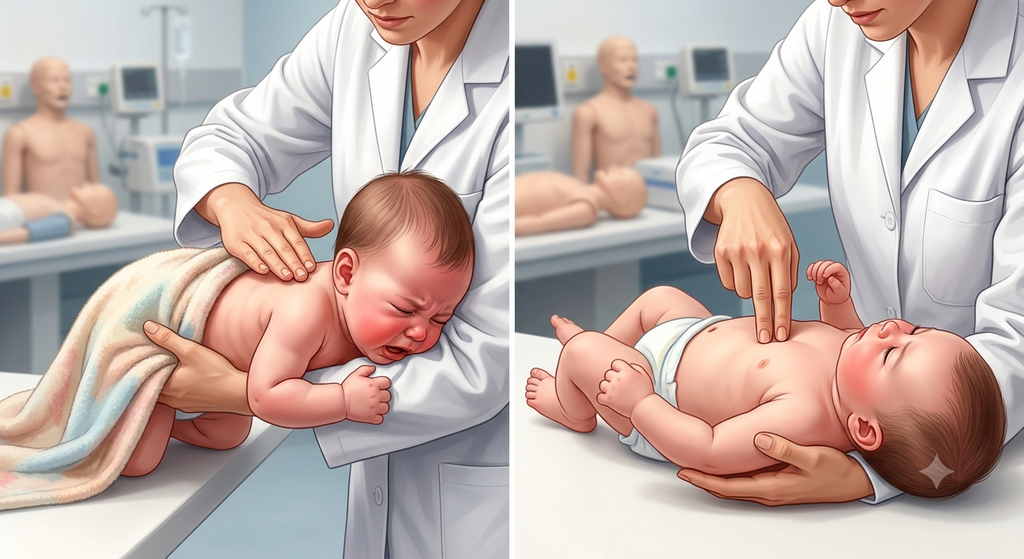
Follow these steps correctly to expel the object safely:
Position for Back Blows
Lay the infant face down along your forearm, with the head lower than the chest. Support the chin and jaw firmly with your hand (note: support only the jawbone; never press on the neck and obstruct the airway). Rest your arm on your thigh for support.
Give 5 Back Blows
Using the heel of your other hand, deliver 5 firm blows between the infant’s shoulder blades, directing the force from back to front and downward.
Turn the Infant & Assess
Using the heel of your other hand, deliver 5 firm blows between the infant’s shoulder blades, directing the force from back to front and downward.
Give 5 Chest Thrusts
Place the index and middle fingers of your free hand on the lower half of the breastbone (about one finger-width below the line connecting the nipples). Press firmly to a depth of about 2.5–4 cm, at a rate of one thrust per second.
Repeat the Cycle
Alternate 5 back blows with 5 chest thrusts until the object comes out, the baby cries loudly and regains normal color, or healthcare professionals arrive.
Unlike adults, young children require highly precise force: too little will not dislodge the object, while too much may fracture the ribs. This is why parents and caregivers should have the opportunity to practice directly and feel the resistance and recoil on a medical-grade infant manikin.
At the Pre-Clinical Skills Simulation Hospital, Phan Chau Trinh University, infant manikins are equipped with advanced force sensors that show whether your back blows and chest thrust placement meet life-saving standards.
Learn this skill today so you can be a reliable source of protection for your child!
Next, we move to an emergency of the highest severity: when someone suddenly collapses and stops breathing because of cardiac arrest — why are chest compressions (CPR) ten times more important than rescue breaths?